AI SEO for Beginners : Exclusive, Best & Easy Tools, Strategies & Best Tips to Grow Your Website to Rank 1st
Introduction
Search is changing faster than ever. People are no longer relying exclusively on traditional search-engine results to find information. AI-powered search experiences are increasingly helping users research topics, compare products, discover businesses, and find answers.
This transformation has created a major opportunity for website owners, bloggers, marketers, and businesses.
AI SEO.
AI SEO combines traditional search engine optimization with artificial intelligence to make activities such as keyword research, content planning, competitor analysis, content optimization, technical SEO, and performance analysis more efficient.
But AI SEO for Beginners is not simply about generating hundreds of AI-written articles and publishing them automatically.
The real goal is to use AI as an assistant while maintaining human expertise, originality, accuracy, and usefulness. Strong SEO fundamentals—such as crawlability, indexing, internal linking, good page experience, and people-first content—continue to form the foundation of successful search optimization.
If you’re Beginner in AI SEO, this guide will walk you through AI SEO step by step and give you Exclusive, Best & Easy Tools, Strategies & Best Tips to Grow Your Website to Rank 1st
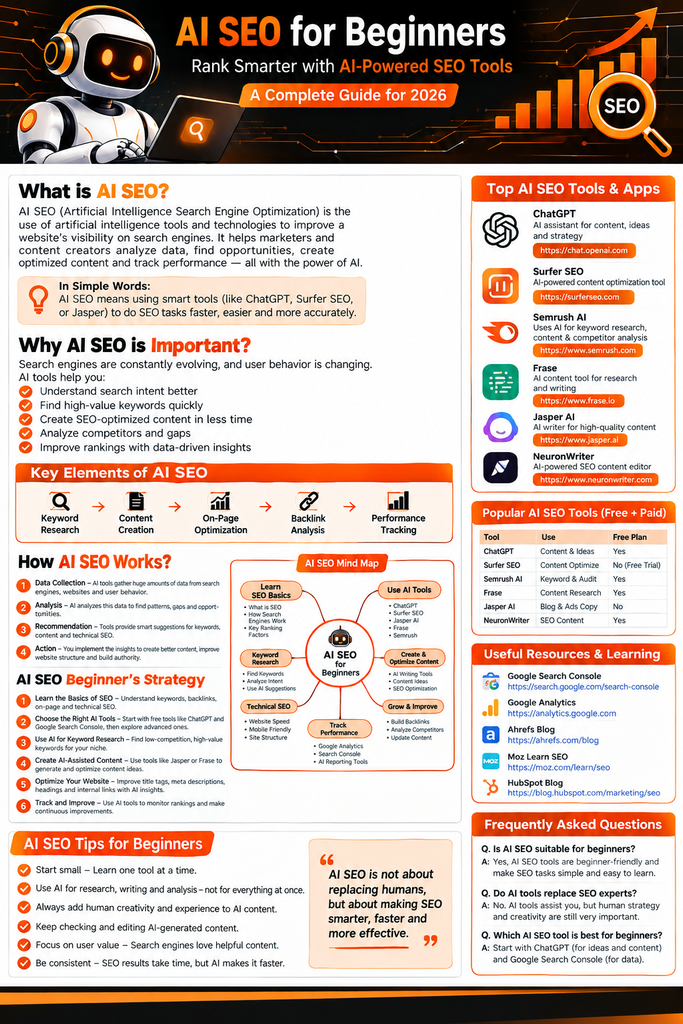
AI SEO for Beginners. Tools, Strategies & Tips to Grow Your Website
What Is AI SEO?
AI SEO is the use of artificial intelligence to support and improve SEO activities and increase a website’s visibility across search engines and AI-powered search experiences.
Traditional SEO often involves manually performing tasks such as:
- Finding keywords
- Studying competitors
- Creating content briefs
- Planning topics
- Monitoring rankings
- Analyzing website performance
- Identifying content gaps
AI can make many of these activities faster.
For example, instead of spending hours brainstorming potential topics, you can use an AI assistant to generate keyword ideas, questions, related topics, and search-intent variations.
However, AI-generated suggestions should not automatically be treated as SEO opportunities. Important keywords and topics should be validated using real SEO data from platforms such as Google Search Console, Semrush, Ahrefs, or other SEO tools.
The key principle is simple:
AI should support your SEO strategy—not replace it.
AI SEO vs. Traditional SEO
AI SEO does not replace traditional SEO. Instead, it adds AI-powered assistance to many existing SEO processes.
| Traditional SEOhttps://digitalspins.in/ | AI-Assisted SEO |
| Manual keyword research | AI-assisted keyword discovery |
| Manual competitor research | AI-assisted competitor analysis |
| Manual content planning | AI-generated content briefs |
| Manual topic clustering | AI-assisted topic clustering |
| Manual content optimization | AI-assisted optimization |
| Manual performance analysis | AI-assisted data interpretation |
| Primarily search-engine focused | Search + AI-search focused |
The fundamentals remain the same: create valuable content and make your website easy for search engines to crawl, understand, and index.
Why Is AI SEO Important?
The way people discover information is evolving.
Imagine someone searches for:
“Best digital marketing agency for a small business in Bilaspur.”
Traditionally, they might browse several search results and visit different websites. With AI-powered search experiences, users may receive summarized answers along with relevant sources and links. This means businesses should think beyond simply ranking for individual keywords.
A well-planned AI SEO for Beginners strategy can help you:
- Discover topics faster
- Understand search intent
- Identify content gaps
- Create detailed content briefs
- Improve existing articles
- Analyze competitors
- Discover internal-linking opportunities
- Monitor search performance
- Understand AI-search visibility
- Reduce repetitive SEO work
AI can therefore become a productivity tool for SEO teams and individual website owners.
How Does AI SEO Work?
A simple AI SEO process looks like this:
Research → Analyze → Plan → Create → Optimize → Publish → Measure → Improve
Let’s understand each stage.
1. Research
Begin by understanding your:
- Target audience
- Customer problems
- Questions
- Search behavior
- Competitors
- Industry
AI can help you brainstorm questions and potential topics, while SEO platforms can help validate their actual search potential.
2. Analyze
Analyze important SEO data, including:
- Keywords
- Competitors
- Existing content
- Backlinks
- Technical issues
- Search performance
- Content gaps
3. Plan
Turn your research into a structured content plan. Topic clusters are particularly useful.
For example, a website targeting Digital Marketing could create supporting content around:
- What Is Digital Marketing?
- SEO for Beginners
- Social Media Marketing
- Google Ads
- Content Marketing
- Email Marketing
- AI SEO
- Local SEO
4. Create
AI can assist with:
- Content outlines
- Headlines
- FAQs
- Research questions
- Content ideas
- Meta descriptions
- Content briefs
However, add your own experience, examples, opinions, insights, and expertise.
5. Optimize
Review and improve:
- Search intent
- Headings
- Internal links
- Title tags
- Meta descriptions
- Images
- Content structure
- Page experience
6. Measure
Use analytics and SEO platforms to determine which pages and topics are performing well.
7. Improve
SEO is an ongoing process.
Update your content based on search data, user behavior, changing information, and performance.
AI SEO Mind Map for Beginners
Think of AI SEO as a combination of several interconnected areas:
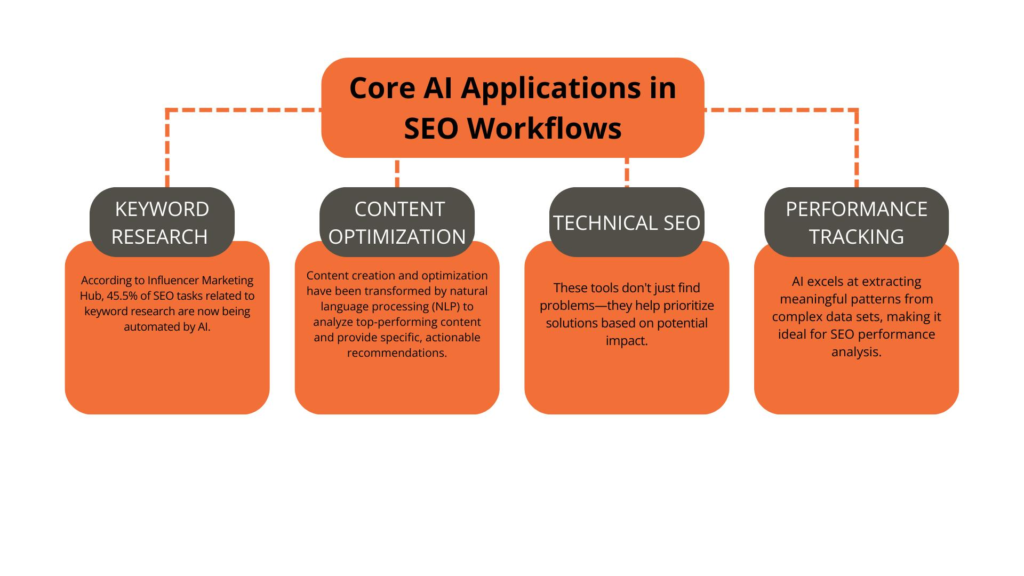
AI SEO for Beginners. Tools, Strategies & Tips to Grow Your Website
AI SEO
→ Keywords
- Keyword research
- Search intent
- Topic clustering
→ Content
- Ideas
- Content briefs
- Writing
- Optimization
→ Technical SEO
- Crawlability
- Indexing
- Website speed
- Mobile experience
→ Analytics
- Search Console
- Analytics
- Rankings
- Traffic
→ AI Tools
- ChatGPT
- Semrush
- Ahrefs
- Surfer SEO
→ Human Expertise
- Experience
- Creativity
- Fact-checking
→ Strategy
- Goals
- Audience
- KPIs
The important takeaway is that AI tools are only one component of SEO—not the entire strategy.
Best AI SEO Tools for Beginners
You don’t need dozens of expensive tools to get started.
A small, focused toolkit can be enough.
1. ChatGPT
ChatGPT can help with:
- Keyword brainstorming
- Content outlines
- Search-intent analysis
- FAQs
- Content ideas
- SEO briefs
- Rewriting
- Competitor research frameworks
Use it as a strategic assistant rather than an automatic content-publishing machine.
2. Google Searhttps://search.google.com/search-consolech Console
Google Search Console is one of the most useful free SEO tools available to beginners.
It can help you understand:
- Which queries generate impressions
- Which queries generate clicks
- Search positions
- Indexing issues
- Search traffic
- Page performance
One of the biggest beginner mistakes is ignoring Search Console data.
AI may suggest hundreds of keyword ideas, but Search Console can show you what people are actually searching for on your website.
3. Google Analytics
Google Analytics helps you understand what happens after visitors reach your website.
You can examine:
- Traffic sources
- Engagement
- Landing pages
- User behavior
- Conversions
- Campaign performance
This information can help you determine whether your SEO traffic is actually contributing to your business goals.
4. Semrushhttps://www.semrush.com/
Semrush provides tools for:
- Keyword research
- Competitor analysis
- Site audits
- Content optimization
- Backlink analysis
- Rank tracking
- AI-search visibility
It can be particularly useful when you want to move beyond basic keyword research and perform deeper competitive analysis.
Ahrefs is widely used for:
- Keyword research
- Backlink analysis
- Competitor research
- Content research
- Site audits
- Rank tracking
It is especially useful for understanding backlinks and analyzing competing websites.
6. Surfer SEO
Surfer SEO focuses heavily on content optimization.
It can help marketers analyze content and identify opportunities to improve pages based on search-related data.
Screaming Frog is useful for technical SEO audits.
It can help identify issues involving:
- Broken links
- Redirects
- Metadata
- Duplicate pages
- Headings
- Canonical tags
- Website structure
How to Use AI for Keyword Research
Keyword research is one of the easiest areas where beginners can start using AI for SEO
Suppose your business offers digital marketing services. You could ask AI to generate keyword ideas around:
“Digital marketing agency.”
You can then organize those ideas according to search intent.
Informational Keywords
Users want information.
Examples:
- What is digital marketing?
- How does SEO work?
- What is AI SEO?
- How to learn digital marketing?
Commercial Keywords
Users are researching products or services.
Examples:
- Best digital marketing agency
- SEO agency pricing
- Digital marketing services
- SEO company for small businesses
Transactional Keywords
Users are closer to taking action.
Examples:
- Hire SEO agency
- Buy SEO services
- Digital marketing agency consultation
Local Keywords
Users are looking for businesses in a particular location.
Examples:
- Digital marketing agency near me
- SEO agency in Bilaspur
- Digital marketing company in Chhattisgarh
AI is excellent for brainstorming keyword categories and variations.
However, don’t blindly trust AI-generated keyword lists.
Use actual SEO data to validate important opportunities.
Building an AI SEO Content Strategy for Beginner
A successful content strategy should start with your audience—not an AI tool.
Before creating content, ask:
Who am I writing for?
Then ask:
What problem are they trying to solve?
For example, instead of simply targeting the broad keyword “SEO,” you could create:
“SEO for Small Businesses: A Step-by-Step Beginner’s Guide.”
You can make the content more valuable by including:
- Practical examples
- Screenshots
- Original insights
- Case studies
- Expert opinions
- Templates
- Checklists
- Videos
- Relevant data
The objective should be to create something genuinely useful rather than simply producing content because an AI tool suggested a topic.
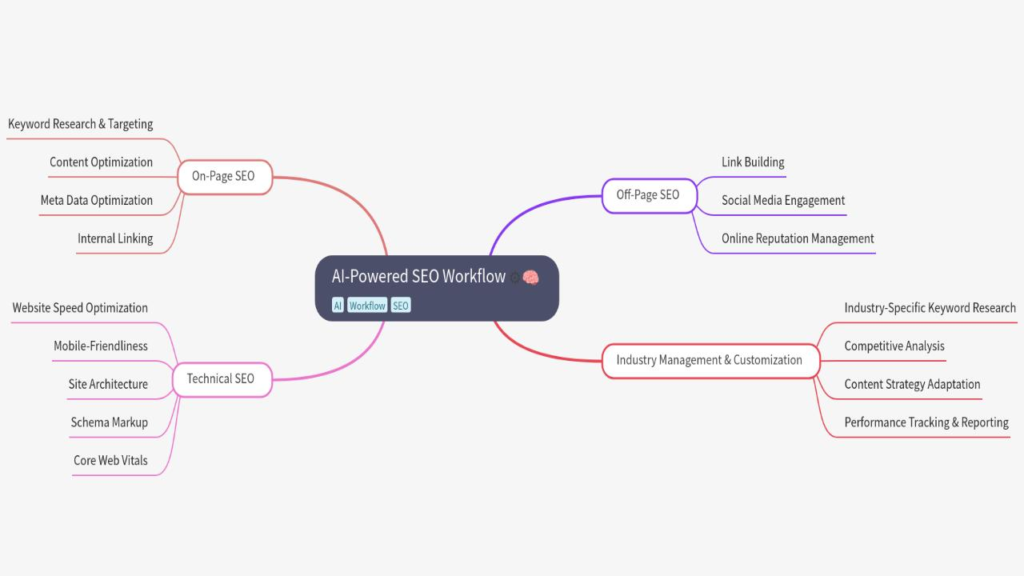
How to Use AI to Create Better Content
AI can speed up content production, but human editing remains essential.
A useful workflow is:
AI Research → Human Research → AI Draft → Human Editing → Fact Checking → SEO Optimization → Publish
For example, AI could help create an initial outline:
- What is AI SEO?
- Why AI SEO matters
- Best AI SEO tools
- AI keyword research
- Content optimization
- Technical SEO
- AI-powered search
- FAQs
You can then strengthen the article by adding your own expertise, examples, data, opinions, and experience.
Don’t publish raw AI-generated content.
Before publishing, make sure you:
- Add personal experience
- Verify facts
- Remove unnecessary repetition
- Include original examples
- Improve readability
- Add useful images
- Add internal links
- Reference trustworthy sources
- Make the content genuinely helpful
AI SEO and Technical SEO
AI cannot fix a technically broken website. Even excellent content can struggle if search engines cannot properly access, understand, or index your pages.
Your website should be:
Crawlable
Search engines should be able to access important pages.
Indexable
Important pages should be eligible for indexing.
Mobile-Friendly
Your website should provide a good experience across smartphones and tablets.
Fast
Pages should load efficiently and provide a good user experience.
Well Structured
Use:
- Clear headings
- Logical navigation
- Internal links
- Descriptive URLs
- Proper content
AI SEO for Beginners : Technical SEO remains an important part of AI-search optimisation
AI SEO, AEO and GEO: What’s the Difference?
You may encounter three common terms:
SEO — Search Engine Optimization
SEO focuses on improving visibility in search engines.
AEO — Answer Engine Optimization
AEO is a term commonly used to describe efforts to make content more suitable for answer-focused search experiences.
GEO — Generative Engine Optimization
GEO generally refers to efforts aimed at improving visibility within generative AI search experiences.
However, don’t get too focused on terminology.
The fundamentals still matter: useful content, good website structure, accessibility, relevant information, and strong SEO practices.
How to Make Your Website AI-Search Friendly
Rather than looking for a secret AI-search trick, focus on the fundamentals.
1. Create Useful Content
Answer genuine questions and solve real problems.
2. Demonstrate Expertise
Include original experience, examples, insights, and useful information.
3. Keep Information Accurate
Fact-check important claims, especially information that could affect business or user decisions.
4. Build a Clear Website Structure
Use logical categories, navigation, and internal links.
5. Make Important Information Available as Text
Don’t hide essential information exclusively inside images or inaccessible elements.
6. Use Useful Visual Content
Relevant images and videos can make content more useful and provide additional opportunities for discovery.
7. Keep Business Information Accurate
Local businesses should maintain consistent and accurate information across relevant platforms.
8. Monitor Performance
Use Search Console and analytics to understand how users are finding and interacting with your content
AI SEO for Beginners Tools, Strategies & Tips to Grow Your Website: 7 Steps
Step 1: Learn SEO Fundamentals
Start with:
- Keywords
- Search intent
- On-page SEO
- Technical SEO
- Backlinks
- Internal linking
- Search Console
Step 2: Choose Your Niche
Select a clear subject area.
Examples include:
- Digital marketing
- Education
- Technology
- Travel
- Finance
- Local businesses
- Health and fitness
Step 3: Research Topics
Use AI for brainstorming and SEO tools for validation.
Step 4: Build Topic Clusters
Create one comprehensive pillar page and several supporting articles around related subtopics.
Step 5: Create High-Quality Content
Use AI to assist with the process, but add human expertise and originality.
Step 6: Optimize
Improve:
- Titles
- Headings
- Internal links
- Images
- Metadata
- Page experience
- Technical SEO
Step 7: Measure
Regularly review Search Console and analytics data.
Then improve pages based on actual performance.
Common AI SEO Mistakes Beginners Should Avoid
Mistake 1: Publishing Hundreds of AI Articles
More content does not automatically mean better rankings.
Focus on quality, relevance, originality, and usefulness instead.
Mistake 2: Ignoring Search Intent
A keyword alone isn’t enough.
Understand why someone is searching for that keyword.
Mistake 3: Trusting AI Facts Without Verification
AI tools can produce inaccurate information.
Always verify important claims before publishing.
Mistake 4: Ignoring Technical SEO
Great content cannot compensate for major technical problems.
Make sure search engines can access and understand your website.
Mistake 5: Keyword Stuffing
Don’t repeatedly insert the same keyword simply to increase keyword frequency.
Write naturally for your audience.
Mistake 6: Copying Competitors
Study competing content to understand what users expect, but look for opportunities to provide additional value rather than simply copying what already exists.
Mistake 7: Forgetting Human Experience
AI can generate text, but your experience, opinions, examples, case studies, and expertise can make content significantly more distinctive.
Free AI SEO Toolkit for Beginners
AI SEO for Beginners. Tools
| Task | Beginner Tool |
| AI brainstorming | ChatGPT |
| Search performance | Google Search Console |
| Website traffic | Google Analytics |
| Keyword research | Semrush / Ahrefs |
| Technical audit | Screaming Frog |
| Content optimization | Surfer SEO |
| Website SEO | WordPress + SEO plugin |
| Content planning | Google Sheets / Notion |
| Image creation | AI image tools |
Start with free or affordable tools and upgrade as your website and business grow.
AI SEO Workflow Example
Suppose you want to create an article titled:
“AI SEO for Small Businesses.”
Your workflow could be:
Step 1: Generate topic variations using AI
↓
Step 2: Validate keywords with SEO tools
↓
Step 3: Study competing pages
↓
Step 4: Identify missing information
↓
Step 5: Build your content outline
↓
Step 6: Write the article
↓
Step 7: Add original examples and insights
↓
Step 8: Optimize headings and internal links
↓
Step 9: Add useful images
↓
Step 10: Publish
↓
Step 11: Monitor Search Console
↓
Step 12: Update the article based on performance
This creates a continuous SEO improvement cycle instead of treating SEO as a one-time activity.
AI SEO Checklist for Beginners
AI SEO for Beginners. Tools, Strategies & Tips to Grow Your Website use these AI SEO Checklist:
Before publishing an SEO-focused article, review the following:
- Understand your target audience
- Identify search intent
- Research relevant keywords
- Analyze competitors
- Build topic clusters
- Create useful content
- Add original insights
- Optimize titles and headings
- Add internal links
- Optimize images
- Check technical SEO
- Submit your sitemap
- Monitor Search Console
- Analyze traffic
- Update older content
- Fact-check AI-generated information
AI SEO for Beginners : Exclusive, Best & Easy Tools, Strategies & Best Tips to Grow Your Website to Rank 1st